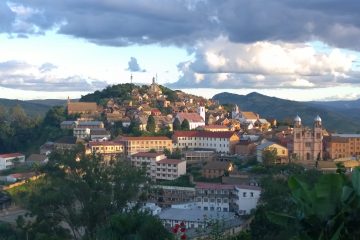
Explore Antananarivo (Tana), the vibrant capital of Madagascar. Discover royal palaces, sacred hills, local markets, and contemporary art spaces in the heart of the city.


🏛️ Rova Manjakamiadana — The Queen’s Palace of Antananarivo
The Rova Manjakamiadana, often called the Palace of the Queen (Palais de la Reine), is one of Madagascar’s most iconic historical monuments. Located at the top of Analamanga Hill in Antananarivo, this palace stands as a symbol of Malagasy monarchy, culture, and national identity.
🌄 Origins of the Rova and the Palace
Although the Manjakamiadana palace itself was built in the 19th century, the Rova of Antananarivo — the royal fortified compound in which it sits — dates back to the early 1600s. The Merina king Andrianjaka seized the strategic hill and established the first royal structure there, laying the foundation of what would become the future capital’s political center.
Over the centuries, successive kings and queens expanded the complex, adding palaces, tombs, temples, and places of ceremony. The Rova became the seat of royal power for the Kingdom of Imerina and later the Kingdom of Madagascar.
👑 Construction of Manjakamiadana — Queen’s Palace
🛠️ Beginnings (1839–1841)
The specific Queen’s Palace (Manjakamiadana) that people know today was commissioned by Queen Ranavalona I (1828–1861). It was designed and built between about 1839 and 1841 by Jean Laborde, a French engineer and adviser at the royal court. At that time the palace was constructed entirely in wood, following the traditional Malagasy style but on a much grander scale.
🧱 Transformation to Stone (1867–1873)
Later in the 19th century, under Queen Ranavalona II, the palace was modified and strengthened. The British architect James Cameron encased the wooden structure in stone, adding galleries, towers, and more durable architectural details that gave the palace its characteristic grandeur. This fusion of Malagasy and European styles made it one of the most distinctive buildings in Madagascar of the era.
📜 Role of the Palace Through History
For much of the 19th century, the Queen’s Palace served as:
✔️ A royal residence for queens and monarchs of the Merina dynasty.
✔️ A political center where kabary (royal speeches) and ceremonial events were held.
✔️ A symbol of sovereignty over the Kingdom of Madagascar.
✔️ A resting place for monarchs and nobles — royal tombs were built within the complex.
Prominent queens such as Ranavalona I, Rasoherina, Ranavalona II, and Ranavalona III all lived and ruled from the Rova during their respective reigns.
⚔️ Colonial Era and Decline
In 1895, French colonial forces invaded Madagascar and eventually ended the monarchy. Queen Ranavalona III was deposed and later exiled by the French, marking the end of royal rule from the Rova.
Under French colonial administration, the palace complex lost its political significance and was repurposed as a museum and cultural site — hosting collections of royal objects and artifacts.
🔥 The Devastating 1995 Fire
On 6 November 1995, the palace suffered a catastrophic fire that destroyed almost all of the wooden structures. Only the stone walls of Manjakamiadana and a few architectural elements survived. This event was a huge shock across Madagascar and represented a massive loss of tangible heritage.
🛠️ Restoration and Modern Revival
Following the fire, a long restoration project began — supported by Malagasy government funds and international partners — to rebuild the palace and other structures within the Rova. Over decades, many parts of the complex were reconstructed authentically, and others restored as museum spaces.
Today, the site is once again open to visitors, showcasing panoramic city views, royal tombs, and exhibits about Madagascar’s monarchical past. The palace stands as both a historical treasure and a place of national remembrance.
🗺️ Cultural and Architectural Significance
The Rova of Manjakamiadana is more than a palace — it is:
✨ A symbol of Malagasy unity and ancient sovereignty.
✨ A testimony to architectural fusion between Malagasy tradition and European influence.
✨ A site of spiritual reverence, connected to ancestor veneration and royal rituals.
✨ One of the most important heritage landmarks in Madagascar and a must-visit for anyone exploring the island’s history.


The Royal Hill of Ambohimanga is one of the most sacred and historically important places in Madagascar.
Located about 24 km northeast of Antananarivo, this fortified royal hill was once the political and spiritual heart of the Merina Kingdom.
In 2001, it was declared a UNESCO World Heritage Site because of its outstanding cultural value.
The name Ambohimanga means “Blue Hill” or “Beautiful Hill.”
The hill was already inhabited in the 15th century, but it became truly important in the 17th century under Merina kings.
It was surrounded by:
-
Massive stone walls
-
Defensive gates
-
Sacred forests
-
Agricultural land
Ambohimanga was both a royal residence and a sacred city.
The most important ruler associated with Ambohimanga is
Andrianampoinimerina
He ruled from 1787 to 1810.
From Ambohimanga, he:
-
Unified the Merina territories
-
Organized administration and laws
-
Strengthened political power
-
Prepared the expansion of the Kingdom of Madagascar
He declared:
“Ny ranomasina no valamparihiko”
“The sea is the boundary of my rice field.”
This meant he wanted to unify the entire island.
Behoririka and Analakely
In the lower town of Antananarivo, two neighborhoods stand out for their energy, color, and intensity: Analakely and Behoririka.
These areas are not monuments or royal palaces — they are living markets, full of daily life. For visitors, they offer a raw and authentic experience of the capital.
🛒 Analakely – The Historic Central Market
Analakely is the traditional commercial heart of Antananarivo.
The name means “small forest,” but today it is a vibrant urban market zone where:
-
Street vendors sell clothes, shoes, bags, and hats
-
Fresh fruits and vegetables are displayed on wooden tables
-
Small shops offer electronics and household goods
-
Local snacks are prepared on the roadside
It is one of the busiest pedestrian areas in the city.
🌆 A Place of History and Daily Life
Analakely has been a trading center since the 19th century. During the colonial period, it became the commercial hub of the lower town.
Today, it represents:
-
Urban Malagasy entrepreneurship
-
Informal economy
-
Everyday life of Antananarivo
For tourists, it is a place to feel the rhythm of the city.
🏬 Behoririka – The Textile and Wholesale District
Just a few minutes away, Behoririka is known for:
-
Fabric shops
-
Wholesale clothing stores
-
Tailoring supplies
-
Affordable fashion
Many local business owners come here to buy goods in bulk.
It is especially lively in the morning when traders and customers negotiate prices.
🚶 Narrow Streets and Intense Atmosphere
One of the most striking characteristics of Analakely and Behoririka is how narrow and crowded the streets can be.
-
Sidewalks are often filled with vendors.
-
Pedestrians share space with cars and taxis.
-
Small alleys connect busy commercial streets.
For some tourists, this can feel overwhelming — but it is also part of the authentic charm.
The markets are:
✔️ Colorful
✔️ Noisy
✔️ Energetic
✔️ Very local
It is a contrast to quiet natural parks or royal hills.
Lisy Art
Lisy Art Tana – A Cultural Shopping Experience in Antananarivo
If you are visiting Antananarivo and looking for high-quality Malagasy art and crafts, Lisy Art Tana is one of the best places to explore.
Unlike the busy street markets of the city, Lisy Art offers a calm, elegant environment where visitors can discover authentic Malagasy creativity in one location.
🎨 Authentic Malagasy Paintings
Lisy Art Tana showcases a variety of paintings created by local Malagasy artists. Visitors can find:
-
Landscapes of Madagascar
-
Daily life scenes from villages and cities
-
Wildlife paintings featuring lemurs and baobabs
-
Contemporary and abstract art
Each piece reflects the colors, culture, and spirit of Madagascar.
For travelers who want more than a simple souvenir, original artwork is a meaningful way to remember their journey.
🧵 High-Quality Handicrafts
Madagascar is famous for its craftsmanship, and Lisy Art highlights this tradition through:
-
Hand-carved wooden sculptures
-
Zebu horn decorative objects
-
Raffia baskets and handmade bags
-
Embroidered tablecloths and textiles
These products are carefully selected and often higher quality than items found in open-air markets.
👗 Malagasy Fashion & Design
The boutique also features:
-
Silk scarves
-
Lamba-inspired creations
-
Locally designed clothing
-
Handmade jewelry
These pieces combine tradition and modern style, making them ideal gifts or personal keepsakes.
🛍️ Why Tourists Prefer Lisy Art Tana
Many travelers appreciate Lisy Art because:
-
Prices are fixed and transparent
-
The atmosphere is calm and organized
-
Products are beautifully presented
-
The quality is reliable
For visitors who may feel overwhelmed by crowded areas like Analakely, Lisy Art provides a comfortable alternative shopping experience.
📍 A Perfect Stop During a City Tour
Located in Antananarivo, Lisy Art can easily be included in a city tour that also explores:
-
The Upper Town
-
Historical royal sites
-
Local neighborhoods
-
Craft markets
It offers a cultural shopping experience while supporting local artists and artisans.
Ambohitrimanjaka
Malagasy Art in Ambohitrimanjaka – A Quiet Cultural Experience Near the Airport
If your clients are staying near Ivato or Talatamaty, visiting Ambohitrimanjaka is an excellent idea.
This area is known for local craftsmanship and traditional Malagasy art, and the best part is:
✅ It is close to the airport
✅ It avoids the heavy traffic of downtown Antananarivo
✅ It offers a more peaceful and authentic atmosphere
🧵 What Type of Malagasy Art Can You Find?
Ambohitrimanjaka is not a big commercial market. Instead, it is known for artisan workshops and handmade products.
Visitors may find:
-
🪵 Wood carvings (animals, baobabs, masks)
-
🧺 Raffia baskets and traditional bags
-
🧶 Embroidered textiles
-
🐂 Zebu horn crafts
-
🖼️ Handmade decorative art pieces
Because it is less touristic than central markets, the prices are often more reasonable and negotiation is easier.
🌿 A More Authentic Atmosphere
Unlike crowded areas like Analakely:
-
Streets are wider and calmer
-
The environment is semi-rural
-
Clients can see artisans working
-
The experience feels more personal
For tourists who prefer quiet cultural stops rather than busy markets, this is a very good alternative.
🚗 Easy Access Without Traffic Jam
One major advantage is accessibility.
From hotels near Ivato Airport or Talatamaty:
-
The drive is short
-
No need to enter central Antananarivo
-
Very little traffic compared to the city center
This makes it ideal:
✔️ Before airport departure
✔️ On arrival day
✔️ During short stays in Tana
You can easily include it in a half-day program.
🛍️ Why It Is Good for Tourists
Ambohitrimanjaka is perfect for:
-
Last-minute souvenir shopping
-
Supporting local artisans directly
-
Experiencing Malagasy culture in a relaxed setting
-
Avoiding stress before a flight
It combines convenience and authenticity.
Pochard
Discover Malagasy art and souvenirs at Pochard in central Antananarivo. A lively local market where visitors can experience daily Malagasy life while shopping for authentic handicrafts.
Malagasy Art in Pochard – Where Culture Meets Daily Life
Located in the center of Antananarivo, Pochard is a lively area where visitors can experience the true rhythm of Malagasy daily life while shopping for souvenirs.
Unlike boutique galleries, Pochard offers a more local and dynamic atmosphere. It is a place where business, culture, and everyday life meet.
🎨 What Can You Find in Pochard?
Pochard is known for small shops and market-style stalls offering a variety of Malagasy handicrafts, including:
-
🪵 Wooden carvings (lemurs, baobabs, masks)
-
🧺 Raffia bags and baskets
-
🐂 Zebu horn jewelry and decorative items
-
🧶 Embroidered tablecloths and textiles
-
🖼️ Handmade paintings and small art pieces
-
🎁 Affordable souvenirs for travelers
Prices are usually negotiable, and bargaining is part of the local shopping culture.
🌍 A Place to Experience Daily Local Life
One of the biggest advantages of visiting Pochard is the atmosphere.
Visitors will see:
-
Street vendors selling fruits and snacks
-
Local people shopping for daily needs
-
Tailors working in small shops
-
Busy pedestrian streets
It is not only a place to buy souvenirs — it is a place to observe the real daily life of Antananarivo.
For tourists who want authenticity, this is a valuable experience.
🚶 Narrow Streets and Local Energy
Like many central areas of Antananarivo, Pochard can be:
-
Busy
-
Narrow
-
Noisy
-
Full of movement
For some visitors, this feels exciting and colorful. For others, it may feel intense. A guide can help make the experience comfortable and enjoyable.
⚠️ Practical Advice for Visitors
To enjoy the visit:
-
Keep personal belongings secure
-
Avoid showing large amounts of cash
-
Stay with your guide in crowded areas
-
Visit during daytime
With basic precautions, the area is generally safe and welcoming.
Why Include Pochard in a City Tour?
✔️ Central location
✔️ Authentic local atmosphere
✔️ Wide variety of souvenirs
✔️ Affordable prices
✔️ Cultural immersion
It is a perfect stop for travelers who want both shopping and cultural experience in one place.
Coum
🎭 A Space for Cultural Exchange
COUM is more than a gallery. It is a meeting place for:
-
Artists
-
Students
-
Cultural enthusiasts
-
International visitors
It represents the evolution of Malagasy art — from traditional forms to modern creative expression.
For travelers interested in culture beyond souvenirs, this is a meaningful experience.
🌍 Why Include COUM in a City Tour?
Including COUM in a guided visit of Antananarivo allows tourists to:
✔️ Understand modern Malagasy society
✔️ Support local artists
✔️ Experience contemporary African art
✔️ Discover a creative side of Madagascar
It pairs well with visits to:
-
Royal historical sites
-
Craft markets
-
Cultural neighborhoods
This contrast shows both the past and the present of Malagasy identity.
Ambohidratrimo is one of the ancient royal hills located northwest of Antananarivo, in the central highlands of Madagascar.
It is part of the famous group known as the “Twelve Sacred Hills of Imerina”, which were the political and spiritual centers of early Merina kingdoms.
👑 1. Origin of the Kingdom of Ambohidratrimo
Before Madagascar became unified under one king, the central highlands were divided into small independent kingdoms.
Ambohidratrimo was one of these early Merina kingdoms.
The kingdom was ruled by local chiefs and kings long before the rise of Antananarivo as the capital.
The name “Ambohidratrimo” means:
-
Ambohitra = hill
-
Ratrimo = name of an early ruler
It is believed the hill was named after a king called Ratrimo, who founded or ruled the area.
⚔️ 2. Political Importance Before Unification
In the 16th and 17th centuries:
-
Imerina was divided into different territories.
-
Each hill had its own king.
-
Rivalries and alliances were common.
Ambohidratrimo was strategically important because:
-
It controlled fertile agricultural land.
-
It had strong natural defenses.
-
It was located near important trade routes.
It was one of the powerful hill kingdoms before unification.
🏰 3. Conquest and Integration into Imerina
The most important turning point came during the reign of:
Andrianampoinimerina
In the late 18th century, he began unifying the Merina territories.
Ambohidratrimo was eventually conquered and integrated into the growing Kingdom of Imerina.
After this:
-
Political power became centralized.
-
Antananarivo became dominant.
-
Ambohidratrimo lost its independence but remained historically significant.
🧬 4. Cultural and Sacred Role
Like other sacred hills, Ambohidratrimo was:
-
A royal residence
-
A burial site for nobles
-
A place of rituals and ancestor worship
The hill contains tombs and traditional structures that reflect Merina customs.
Even after political unification, the hill kept its spiritual importance.
🌄 5. Part of the Twelve Sacred Hills of Imerina
Ambohidratrimo is included among the sacred hills associated with early Merina royalty.
These hills symbolize:
-
The origins of the Merina people
-
The fragmentation of early kingdoms
-
The process of unification
-
The roots of Malagasy statehood
Each hill represents a chapter in the formation of Madagascar’s central monarchy.
Visit Croc Farm near Ivato Airport in Antananarivo. Discover Nile crocodiles, lemurs, chameleons, and a botanical garden just minutes from the airport.
Croc Farm Antananarivo – A Perfect Nature Stop Near the Airport
Located near Ivato, close to Antananarivo, Croc Farm is one of the easiest wildlife attractions to visit in Tana.
Only a few minutes from Ivato International Airport, it is ideal for:
-
First day in Madagascar
-
Last day before departure
-
Short stay in Antananarivo
-
Families with children
🐊 1. Nile Crocodiles
The main attraction is the Nile crocodile (Crocodylus niloticus).
Visitors can see:
-
Adult crocodiles
-
Young crocodiles
-
Feeding sessions (depending on schedule)
-
Breeding areas
It is a safe and educational experience to learn about Madagascar’s reptiles.
🐒 2. Lemurs and Endemic Animals
Croc Farm is not only about crocodiles. You can also see:
-
Different species of lemurs
-
Chameleons
-
Tortoises
-
Snakes
-
Frogs
This makes it a mini introduction to Madagascar’s unique biodiversity.
For travelers who cannot visit national parks like Andasibe, Croc Farm offers a small preview of Malagasy wildlife.
🌿 3. Botanical Garden
The park includes a beautiful garden with:
-
Tropical plants
-
Palm trees
-
Local Malagasy vegetation
-
Small lakes and green spaces
It is peaceful and good for photography.
🍽️ 4. Restaurant & Relaxing Area
Croc Farm also has:
-
A restaurant serving Malagasy and international dishes
-
Outdoor seating
-
A calm atmosphere away from city traffic
It is a comfortable stop for lunch or dinner near the airport.
🏛️ Rova Manjakamiadana — The Queen’s Palace of Antananarivo
The Rova Manjakamiadana, often called the Palace of the Queen (Palais de la Reine), is one of Madagascar’s most iconic historical monuments. Located at the top of Analamanga Hill in Antananarivo, this palace stands as a symbol of Malagasy monarchy, culture, and national identity.
🌄 Origins of the Rova and the Palace
Although the Manjakamiadana palace itself was built in the 19th century, the Rova of Antananarivo — the royal fortified compound in which it sits — dates back to the early 1600s. The Merina king Andrianjaka seized the strategic hill and established the first royal structure there, laying the foundation of what would become the future capital’s political center.
Over the centuries, successive kings and queens expanded the complex, adding palaces, tombs, temples, and places of ceremony. The Rova became the seat of royal power for the Kingdom of Imerina and later the Kingdom of Madagascar.
👑 Construction of Manjakamiadana — Queen’s Palace
🛠️ Beginnings (1839–1841)
The specific Queen’s Palace (Manjakamiadana) that people know today was commissioned by Queen Ranavalona I (1828–1861). It was designed and built between about 1839 and 1841 by Jean Laborde, a French engineer and adviser at the royal court. At that time the palace was constructed entirely in wood, following the traditional Malagasy style but on a much grander scale.
🧱 Transformation to Stone (1867–1873)
Later in the 19th century, under Queen Ranavalona II, the palace was modified and strengthened. The British architect James Cameron encased the wooden structure in stone, adding galleries, towers, and more durable architectural details that gave the palace its characteristic grandeur. This fusion of Malagasy and European styles made it one of the most distinctive buildings in Madagascar of the era.
📜 Role of the Palace Through History
For much of the 19th century, the Queen’s Palace served as:
✔️ A royal residence for queens and monarchs of the Merina dynasty.
✔️ A political center where kabary (royal speeches) and ceremonial events were held.
✔️ A symbol of sovereignty over the Kingdom of Madagascar.
✔️ A resting place for monarchs and nobles — royal tombs were built within the complex.
Prominent queens such as Ranavalona I, Rasoherina, Ranavalona II, and Ranavalona III all lived and ruled from the Rova during their respective reigns.
⚔️ Colonial Era and Decline
In 1895, French colonial forces invaded Madagascar and eventually ended the monarchy. Queen Ranavalona III was deposed and later exiled by the French, marking the end of royal rule from the Rova.
Under French colonial administration, the palace complex lost its political significance and was repurposed as a museum and cultural site — hosting collections of royal objects and artifacts.
🔥 The Devastating 1995 Fire
On 6 November 1995, the palace suffered a catastrophic fire that destroyed almost all of the wooden structures. Only the stone walls of Manjakamiadana and a few architectural elements survived. This event was a huge shock across Madagascar and represented a massive loss of tangible heritage.
🛠️ Restoration and Modern Revival
Following the fire, a long restoration project began — supported by Malagasy government funds and international partners — to rebuild the palace and other structures within the Rova. Over decades, many parts of the complex were reconstructed authentically, and others restored as museum spaces.
Today, the site is once again open to visitors, showcasing panoramic city views, royal tombs, and exhibits about Madagascar’s monarchical past. The palace stands as both a historical treasure and a place of national remembrance.
🗺️ Cultural and Architectural Significance
The Rova of Manjakamiadana is more than a palace — it is:
✨ A symbol of Malagasy unity and ancient sovereignty.
✨ A testimony to architectural fusion between Malagasy tradition and European influence.
✨ A site of spiritual reverence, connected to ancestor veneration and royal rituals.
✨ One of the most important heritage landmarks in Madagascar and a must-visit for anyone exploring the island’s history.
The Royal Hill of Ambohimanga is one of the most sacred and historically important places in Madagascar.
Located about 24 km northeast of Antananarivo, this fortified royal hill was once the political and spiritual heart of the Merina Kingdom.
In 2001, it was declared a UNESCO World Heritage Site because of its outstanding cultural value.
The name Ambohimanga means “Blue Hill” or “Beautiful Hill.”
The hill was already inhabited in the 15th century, but it became truly important in the 17th century under Merina kings.
It was surrounded by:
-
Massive stone walls
-
Defensive gates
-
Sacred forests
-
Agricultural land
Ambohimanga was both a royal residence and a sacred city.
The most important ruler associated with Ambohimanga is
Andrianampoinimerina
He ruled from 1787 to 1810.
From Ambohimanga, he:
-
Unified the Merina territories
-
Organized administration and laws
-
Strengthened political power
-
Prepared the expansion of the Kingdom of Madagascar
He declared:
“Ny ranomasina no valamparihiko”
“The sea is the boundary of my rice field.”
This meant he wanted to unify the entire island.
Behoririka and Analakely
In the lower town of Antananarivo, two neighborhoods stand out for their energy, color, and intensity: Analakely and Behoririka.
These areas are not monuments or royal palaces — they are living markets, full of daily life. For visitors, they offer a raw and authentic experience of the capital.
🛒 Analakely – The Historic Central Market
Analakely is the traditional commercial heart of Antananarivo.
The name means “small forest,” but today it is a vibrant urban market zone where:
-
Street vendors sell clothes, shoes, bags, and hats
-
Fresh fruits and vegetables are displayed on wooden tables
-
Small shops offer electronics and household goods
-
Local snacks are prepared on the roadside
It is one of the busiest pedestrian areas in the city.
🌆 A Place of History and Daily Life
Analakely has been a trading center since the 19th century. During the colonial period, it became the commercial hub of the lower town.
Today, it represents:
-
Urban Malagasy entrepreneurship
-
Informal economy
-
Everyday life of Antananarivo
For tourists, it is a place to feel the rhythm of the city.
🏬 Behoririka – The Textile and Wholesale District
Just a few minutes away, Behoririka is known for:
-
Fabric shops
-
Wholesale clothing stores
-
Tailoring supplies
-
Affordable fashion
Many local business owners come here to buy goods in bulk.
It is especially lively in the morning when traders and customers negotiate prices.
🚶 Narrow Streets and Intense Atmosphere
One of the most striking characteristics of Analakely and Behoririka is how narrow and crowded the streets can be.
-
Sidewalks are often filled with vendors.
-
Pedestrians share space with cars and taxis.
-
Small alleys connect busy commercial streets.
For some tourists, this can feel overwhelming — but it is also part of the authentic charm.
The markets are:
✔️ Colorful
✔️ Noisy
✔️ Energetic
✔️ Very local
It is a contrast to quiet natural parks or royal hills.
Lisy Art
Lisy Art Tana – A Cultural Shopping Experience in Antananarivo
If you are visiting Antananarivo and looking for high-quality Malagasy art and crafts, Lisy Art Tana is one of the best places to explore.
Unlike the busy street markets of the city, Lisy Art offers a calm, elegant environment where visitors can discover authentic Malagasy creativity in one location.
🎨 Authentic Malagasy Paintings
Lisy Art Tana showcases a variety of paintings created by local Malagasy artists. Visitors can find:
-
Landscapes of Madagascar
-
Daily life scenes from villages and cities
-
Wildlife paintings featuring lemurs and baobabs
-
Contemporary and abstract art
Each piece reflects the colors, culture, and spirit of Madagascar.
For travelers who want more than a simple souvenir, original artwork is a meaningful way to remember their journey.
🧵 High-Quality Handicrafts
Madagascar is famous for its craftsmanship, and Lisy Art highlights this tradition through:
-
Hand-carved wooden sculptures
-
Zebu horn decorative objects
-
Raffia baskets and handmade bags
-
Embroidered tablecloths and textiles
These products are carefully selected and often higher quality than items found in open-air markets.
👗 Malagasy Fashion & Design
The boutique also features:
-
Silk scarves
-
Lamba-inspired creations
-
Locally designed clothing
-
Handmade jewelry
These pieces combine tradition and modern style, making them ideal gifts or personal keepsakes.
🛍️ Why Tourists Prefer Lisy Art Tana
Many travelers appreciate Lisy Art because:
-
Prices are fixed and transparent
-
The atmosphere is calm and organized
-
Products are beautifully presented
-
The quality is reliable
For visitors who may feel overwhelmed by crowded areas like Analakely, Lisy Art provides a comfortable alternative shopping experience.
📍 A Perfect Stop During a City Tour
Located in Antananarivo, Lisy Art can easily be included in a city tour that also explores:
-
The Upper Town
-
Historical royal sites
-
Local neighborhoods
-
Craft markets
It offers a cultural shopping experience while supporting local artists and artisans.
Ambohitrimanjaka
Malagasy Art in Ambohitrimanjaka – A Quiet Cultural Experience Near the Airport
If your clients are staying near Ivato or Talatamaty, visiting Ambohitrimanjaka is an excellent idea.
This area is known for local craftsmanship and traditional Malagasy art, and the best part is:
✅ It is close to the airport
✅ It avoids the heavy traffic of downtown Antananarivo
✅ It offers a more peaceful and authentic atmosphere
🧵 What Type of Malagasy Art Can You Find?
Ambohitrimanjaka is not a big commercial market. Instead, it is known for artisan workshops and handmade products.
Visitors may find:
-
🪵 Wood carvings (animals, baobabs, masks)
-
🧺 Raffia baskets and traditional bags
-
🧶 Embroidered textiles
-
🐂 Zebu horn crafts
-
🖼️ Handmade decorative art pieces
Because it is less touristic than central markets, the prices are often more reasonable and negotiation is easier.
🌿 A More Authentic Atmosphere
Unlike crowded areas like Analakely:
-
Streets are wider and calmer
-
The environment is semi-rural
-
Clients can see artisans working
-
The experience feels more personal
For tourists who prefer quiet cultural stops rather than busy markets, this is a very good alternative.
🚗 Easy Access Without Traffic Jam
One major advantage is accessibility.
From hotels near Ivato Airport or Talatamaty:
-
The drive is short
-
No need to enter central Antananarivo
-
Very little traffic compared to the city center
This makes it ideal:
✔️ Before airport departure
✔️ On arrival day
✔️ During short stays in Tana
You can easily include it in a half-day program.
🛍️ Why It Is Good for Tourists
Ambohitrimanjaka is perfect for:
-
Last-minute souvenir shopping
-
Supporting local artisans directly
-
Experiencing Malagasy culture in a relaxed setting
-
Avoiding stress before a flight
It combines convenience and authenticity.
Pochard
Discover Malagasy art and souvenirs at Pochard in central Antananarivo. A lively local market where visitors can experience daily Malagasy life while shopping for authentic handicrafts.
Malagasy Art in Pochard – Where Culture Meets Daily Life
Located in the center of Antananarivo, Pochard is a lively area where visitors can experience the true rhythm of Malagasy daily life while shopping for souvenirs.
Unlike boutique galleries, Pochard offers a more local and dynamic atmosphere. It is a place where business, culture, and everyday life meet.
🎨 What Can You Find in Pochard?
Pochard is known for small shops and market-style stalls offering a variety of Malagasy handicrafts, including:
-
🪵 Wooden carvings (lemurs, baobabs, masks)
-
🧺 Raffia bags and baskets
-
🐂 Zebu horn jewelry and decorative items
-
🧶 Embroidered tablecloths and textiles
-
🖼️ Handmade paintings and small art pieces
-
🎁 Affordable souvenirs for travelers
Prices are usually negotiable, and bargaining is part of the local shopping culture.
🌍 A Place to Experience Daily Local Life
One of the biggest advantages of visiting Pochard is the atmosphere.
Visitors will see:
-
Street vendors selling fruits and snacks
-
Local people shopping for daily needs
-
Tailors working in small shops
-
Busy pedestrian streets
It is not only a place to buy souvenirs — it is a place to observe the real daily life of Antananarivo.
For tourists who want authenticity, this is a valuable experience.
🚶 Narrow Streets and Local Energy
Like many central areas of Antananarivo, Pochard can be:
-
Busy
-
Narrow
-
Noisy
-
Full of movement
For some visitors, this feels exciting and colorful. For others, it may feel intense. A guide can help make the experience comfortable and enjoyable.
⚠️ Practical Advice for Visitors
To enjoy the visit:
-
Keep personal belongings secure
-
Avoid showing large amounts of cash
-
Stay with your guide in crowded areas
-
Visit during daytime
With basic precautions, the area is generally safe and welcoming.
Why Include Pochard in a City Tour?
✔️ Central location
✔️ Authentic local atmosphere
✔️ Wide variety of souvenirs
✔️ Affordable prices
✔️ Cultural immersion
It is a perfect stop for travelers who want both shopping and cultural experience in one place.
Coum
🎭 A Space for Cultural Exchange
COUM is more than a gallery. It is a meeting place for:
-
Artists
-
Students
-
Cultural enthusiasts
-
International visitors
It represents the evolution of Malagasy art — from traditional forms to modern creative expression.
For travelers interested in culture beyond souvenirs, this is a meaningful experience.
🌍 Why Include COUM in a City Tour?
Including COUM in a guided visit of Antananarivo allows tourists to:
✔️ Understand modern Malagasy society
✔️ Support local artists
✔️ Experience contemporary African art
✔️ Discover a creative side of Madagascar
It pairs well with visits to:
-
Royal historical sites
-
Craft markets
-
Cultural neighborhoods
This contrast shows both the past and the present of Malagasy identity.
In the lower town of Antananarivo, two neighborhoods stand out for their energy, color, and intensity: Analakely and Behoririka.
These areas are not monuments or royal palaces — they are living markets, full of daily life. For visitors, they offer a raw and authentic experience of the capital.
🛒 Analakely – The Historic Central Market
Analakely is the traditional commercial heart of Antananarivo.
The name means “small forest,” but today it is a vibrant urban market zone where:
-
Street vendors sell clothes, shoes, bags, and hats
-
Fresh fruits and vegetables are displayed on wooden tables
-
Small shops offer electronics and household goods
-
Local snacks are prepared on the roadside
It is one of the busiest pedestrian areas in the city.
🌆 A Place of History and Daily Life
Analakely has been a trading center since the 19th century. During the colonial period, it became the commercial hub of the lower town.
Today, it represents:
-
Urban Malagasy entrepreneurship
-
Informal economy
-
Everyday life of Antananarivo
For tourists, it is a place to feel the rhythm of the city.
🏬 Behoririka – The Textile and Wholesale District
Just a few minutes away, Behoririka is known for:
-
Fabric shops
-
Wholesale clothing stores
-
Tailoring supplies
-
Affordable fashion
Many local business owners come here to buy goods in bulk.
It is especially lively in the morning when traders and customers negotiate prices.
🚶 Narrow Streets and Intense Atmosphere
One of the most striking characteristics of Analakely and Behoririka is how narrow and crowded the streets can be.
-
Sidewalks are often filled with vendors.
-
Pedestrians share space with cars and taxis.
-
Small alleys connect busy commercial streets.
For some tourists, this can feel overwhelming — but it is also part of the authentic charm.
The markets are:
✔️ Colorful
✔️ Noisy
✔️ Energetic
✔️ Very local
It is a contrast to quiet natural parks or royal hills.
Lisy Art Tana – A Cultural Shopping Experience in Antananarivo
If you are visiting Antananarivo and looking for high-quality Malagasy art and crafts, Lisy Art Tana is one of the best places to explore.
Unlike the busy street markets of the city, Lisy Art offers a calm, elegant environment where visitors can discover authentic Malagasy creativity in one location.
🎨 Authentic Malagasy Paintings
Lisy Art Tana showcases a variety of paintings created by local Malagasy artists. Visitors can find:
-
Landscapes of Madagascar
-
Daily life scenes from villages and cities
-
Wildlife paintings featuring lemurs and baobabs
-
Contemporary and abstract art
Each piece reflects the colors, culture, and spirit of Madagascar.
For travelers who want more than a simple souvenir, original artwork is a meaningful way to remember their journey.
🧵 High-Quality Handicrafts
Madagascar is famous for its craftsmanship, and Lisy Art highlights this tradition through:
-
Hand-carved wooden sculptures
-
Zebu horn decorative objects
-
Raffia baskets and handmade bags
-
Embroidered tablecloths and textiles
These products are carefully selected and often higher quality than items found in open-air markets.
👗 Malagasy Fashion & Design
The boutique also features:
-
Silk scarves
-
Lamba-inspired creations
-
Locally designed clothing
-
Handmade jewelry
These pieces combine tradition and modern style, making them ideal gifts or personal keepsakes.
🛍️ Why Tourists Prefer Lisy Art Tana
Many travelers appreciate Lisy Art because:
-
Prices are fixed and transparent
-
The atmosphere is calm and organized
-
Products are beautifully presented
-
The quality is reliable
For visitors who may feel overwhelmed by crowded areas like Analakely, Lisy Art provides a comfortable alternative shopping experience.
📍 A Perfect Stop During a City Tour
Located in Antananarivo, Lisy Art can easily be included in a city tour that also explores:
-
The Upper Town
-
Historical royal sites
-
Local neighborhoods
-
Craft markets
It offers a cultural shopping experience while supporting local artists and artisans.
Malagasy Art in Ambohitrimanjaka – A Quiet Cultural Experience Near the Airport
If your clients are staying near Ivato or Talatamaty, visiting Ambohitrimanjaka is an excellent idea.
This area is known for local craftsmanship and traditional Malagasy art, and the best part is:
✅ It is close to the airport
✅ It avoids the heavy traffic of downtown Antananarivo
✅ It offers a more peaceful and authentic atmosphere
🧵 What Type of Malagasy Art Can You Find?
Ambohitrimanjaka is not a big commercial market. Instead, it is known for artisan workshops and handmade products.
Visitors may find:
-
🪵 Wood carvings (animals, baobabs, masks)
-
🧺 Raffia baskets and traditional bags
-
🧶 Embroidered textiles
-
🐂 Zebu horn crafts
-
🖼️ Handmade decorative art pieces
Because it is less touristic than central markets, the prices are often more reasonable and negotiation is easier.
🌿 A More Authentic Atmosphere
Unlike crowded areas like Analakely:
-
Streets are wider and calmer
-
The environment is semi-rural
-
Clients can see artisans working
-
The experience feels more personal
For tourists who prefer quiet cultural stops rather than busy markets, this is a very good alternative.
🚗 Easy Access Without Traffic Jam
One major advantage is accessibility.
From hotels near Ivato Airport or Talatamaty:
-
The drive is short
-
No need to enter central Antananarivo
-
Very little traffic compared to the city center
This makes it ideal:
✔️ Before airport departure
✔️ On arrival day
✔️ During short stays in Tana
You can easily include it in a half-day program.
🛍️ Why It Is Good for Tourists
Ambohitrimanjaka is perfect for:
-
Last-minute souvenir shopping
-
Supporting local artisans directly
-
Experiencing Malagasy culture in a relaxed setting
-
Avoiding stress before a flight
It combines convenience and authenticity.
Discover Malagasy art and souvenirs at Pochard in central Antananarivo. A lively local market where visitors can experience daily Malagasy life while shopping for authentic handicrafts.
Malagasy Art in Pochard – Where Culture Meets Daily Life
Located in the center of Antananarivo, Pochard is a lively area where visitors can experience the true rhythm of Malagasy daily life while shopping for souvenirs.
Unlike boutique galleries, Pochard offers a more local and dynamic atmosphere. It is a place where business, culture, and everyday life meet.
🎨 What Can You Find in Pochard?
Pochard is known for small shops and market-style stalls offering a variety of Malagasy handicrafts, including:
-
🪵 Wooden carvings (lemurs, baobabs, masks)
-
🧺 Raffia bags and baskets
-
🐂 Zebu horn jewelry and decorative items
-
🧶 Embroidered tablecloths and textiles
-
🖼️ Handmade paintings and small art pieces
-
🎁 Affordable souvenirs for travelers
Prices are usually negotiable, and bargaining is part of the local shopping culture.
🌍 A Place to Experience Daily Local Life
One of the biggest advantages of visiting Pochard is the atmosphere.
Visitors will see:
-
Street vendors selling fruits and snacks
-
Local people shopping for daily needs
-
Tailors working in small shops
-
Busy pedestrian streets
It is not only a place to buy souvenirs — it is a place to observe the real daily life of Antananarivo.
For tourists who want authenticity, this is a valuable experience.
🚶 Narrow Streets and Local Energy
Like many central areas of Antananarivo, Pochard can be:
-
Busy
-
Narrow
-
Noisy
-
Full of movement
For some visitors, this feels exciting and colorful. For others, it may feel intense. A guide can help make the experience comfortable and enjoyable.
⚠️ Practical Advice for Visitors
To enjoy the visit:
-
Keep personal belongings secure
-
Avoid showing large amounts of cash
-
Stay with your guide in crowded areas
-
Visit during daytime
With basic precautions, the area is generally safe and welcoming.
Why Include Pochard in a City Tour?
✔️ Central location
✔️ Authentic local atmosphere
✔️ Wide variety of souvenirs
✔️ Affordable prices
✔️ Cultural immersion
It is a perfect stop for travelers who want both shopping and cultural experience in one place.
🎭 A Space for Cultural Exchange
COUM is more than a gallery. It is a meeting place for:
-
Artists
-
Students
-
Cultural enthusiasts
-
International visitors
It represents the evolution of Malagasy art — from traditional forms to modern creative expression.
For travelers interested in culture beyond souvenirs, this is a meaningful experience.
🌍 Why Include COUM in a City Tour?
Including COUM in a guided visit of Antananarivo allows tourists to:
✔️ Understand modern Malagasy society
✔️ Support local artists
✔️ Experience contemporary African art
✔️ Discover a creative side of Madagascar
It pairs well with visits to:
-
Royal historical sites
-
Craft markets
-
Cultural neighborhoods
This contrast shows both the past and the present of Malagasy identity.
Ambohidratrimo is one of the ancient royal hills located northwest of Antananarivo, in the central highlands of Madagascar.
It is part of the famous group known as the “Twelve Sacred Hills of Imerina”, which were the political and spiritual centers of early Merina kingdoms.
👑 1. Origin of the Kingdom of Ambohidratrimo
Before Madagascar became unified under one king, the central highlands were divided into small independent kingdoms.
Ambohidratrimo was one of these early Merina kingdoms.
The kingdom was ruled by local chiefs and kings long before the rise of Antananarivo as the capital.
The name “Ambohidratrimo” means:
-
Ambohitra = hill
-
Ratrimo = name of an early ruler
It is believed the hill was named after a king called Ratrimo, who founded or ruled the area.
⚔️ 2. Political Importance Before Unification
In the 16th and 17th centuries:
-
Imerina was divided into different territories.
-
Each hill had its own king.
-
Rivalries and alliances were common.
Ambohidratrimo was strategically important because:
-
It controlled fertile agricultural land.
-
It had strong natural defenses.
-
It was located near important trade routes.
It was one of the powerful hill kingdoms before unification.
🏰 3. Conquest and Integration into Imerina
The most important turning point came during the reign of:
Andrianampoinimerina
In the late 18th century, he began unifying the Merina territories.
Ambohidratrimo was eventually conquered and integrated into the growing Kingdom of Imerina.
After this:
-
Political power became centralized.
-
Antananarivo became dominant.
-
Ambohidratrimo lost its independence but remained historically significant.
🧬 4. Cultural and Sacred Role
Like other sacred hills, Ambohidratrimo was:
-
A royal residence
-
A burial site for nobles
-
A place of rituals and ancestor worship
The hill contains tombs and traditional structures that reflect Merina customs.
Even after political unification, the hill kept its spiritual importance.
🌄 5. Part of the Twelve Sacred Hills of Imerina
Ambohidratrimo is included among the sacred hills associated with early Merina royalty.
These hills symbolize:
-
The origins of the Merina people
-
The fragmentation of early kingdoms
-
The process of unification
-
The roots of Malagasy statehood
Each hill represents a chapter in the formation of Madagascar’s central monarchy.
Visit Croc Farm near Ivato Airport in Antananarivo. Discover Nile crocodiles, lemurs, chameleons, and a botanical garden just minutes from the airport.
Croc Farm Antananarivo – A Perfect Nature Stop Near the Airport
Located near Ivato, close to Antananarivo, Croc Farm is one of the easiest wildlife attractions to visit in Tana.
Only a few minutes from Ivato International Airport, it is ideal for:
-
First day in Madagascar
-
Last day before departure
-
Short stay in Antananarivo
-
Families with children
🐊 1. Nile Crocodiles
The main attraction is the Nile crocodile (Crocodylus niloticus).
Visitors can see:
-
Adult crocodiles
-
Young crocodiles
-
Feeding sessions (depending on schedule)
-
Breeding areas
It is a safe and educational experience to learn about Madagascar’s reptiles.
🐒 2. Lemurs and Endemic Animals
Croc Farm is not only about crocodiles. You can also see:
-
Different species of lemurs
-
Chameleons
-
Tortoises
-
Snakes
-
Frogs
This makes it a mini introduction to Madagascar’s unique biodiversity.
For travelers who cannot visit national parks like Andasibe, Croc Farm offers a small preview of Malagasy wildlife.
🌿 3. Botanical Garden
The park includes a beautiful garden with:
-
Tropical plants
-
Palm trees
-
Local Malagasy vegetation
-
Small lakes and green spaces
It is peaceful and good for photography.
🍽️ 4. Restaurant & Relaxing Area
Croc Farm also has:
-
A restaurant serving Malagasy and international dishes
-
Outdoor seating
-
A calm atmosphere away from city traffic
It is a comfortable stop for lunch or dinner near the airport.